
Spending a Saturday morning pulling weeds along the block wall, checking the pool chemistry near Vistancia, or getting the grill ready for evening company out on the patio are the kinds of routines that make a Peoria AZ backyard worth having. Most people who invest that kind of time and energy into their outdoor spaces are focused on the plants, the surface, and the furniture. The pests operating just below and around those same spaces are focused on something else entirely: survival as the desert heat builds toward its annual peak.
What makes late spring and early summer so significant for pest control in Peoria AZ is that it is the period between predictable cold and predictable rain. Desert pests do not wait for the monsoons. They respond to temperature, and by May, the ground around Arrowhead Ranch neighborhoods, along the Bell Road corridor, and out near the growing developments off the Loop 101 is warm enough to accelerate insect activity, push scorpions into new territory, and drive rodents closer to structures that offer shade and access to food.
Understanding what is actually happening during this pre-monsoon window gives you a real edge when it comes to protecting the yard and outdoor spaces you have worked hard to maintain.
What the Heat Does to Pest Behavior
Arizona heat does not kill most common pests. It reorganizes them. When daytime highs in Peoria climb past 95 and 100 degrees in May and June, soil temperatures near the surface become inhospitable for insects that cannot regulate their body temperature. The response is movement, and that movement almost always has a direction: toward water, food, shade, and the cool margins of a structure.
Ant colonies are a clear example. Peoria yards with drip irrigation systems, decorative boulders, block wall footings, or even a bird bath are sitting on top of prime summer ant habitat. Desert fire ants and pavement ants both expand their foraging territory as temperatures climb, pushing visible trails farther from the colony and into patios, door thresholds, and garage floors. The ant infestations that seem to appear overnight in June are rarely new colonies. They are established colonies responding to heat stress by increasing the range of food search activity.
Cockroaches follow a similar pattern. American cockroaches, which thrive in the drainage systems and utility corridors common in Maricopa County construction, become dramatically more mobile in warm weather. If you have noticed them near the outdoor hose bib, under the back steps, or inside the garage late in the evening, that is a pre-monsoon behavioral shift. They are not reacting to rain that has not arrived yet. They are reacting to heat that has.
Scorpion Pressure in Peoria Yards
Scorpions are the pest most outdoor-focused homeowners in Peoria AZ take seriously, and for good reason. The Arizona bark scorpion, the only scorpion in the United States considered medically significant, is common throughout the western Maricopa County area. Peoria sits in prime territory, with adjacent desert preserves, new construction activity displacing populations near Lake Pleasant, and mature landscaping in established neighborhoods providing the kind of debris and rock cover scorpions prefer to rest under during daylight hours.
Pre-monsoon is when scorpion sightings in yards, on back patios, and near pool equipment tend to increase sharply. The reason is straightforward: scorpions are hunting insects, and their prey becomes more active in the heat. If ants, crickets, and other small insects are moving through your yard more aggressively in May and June, scorpions follow. Adding outdoor lighting that attracts flying insects near the pool or patio creates an insect buffet that scorpions learn to frequent.
Families who spend evenings outside, let kids run barefoot on the grass or near the pool deck, or have dogs and cats that roam the yard at dusk should treat scorpion season in Peoria as starting well before the first monsoon storm. Green Magic Pest Control offers Black Light Scorpion Service specifically designed to locate and eliminate scorpion populations before activity peaks.
Termites and the Pre-Rain Window
Subterranean termites in Arizona swarm after rain events, and most homeowners connect termite activity to monsoon season. What often gets missed is that the colony doing the damage underneath a Peoria property does not wait for rain to eat wood. Termite colonies in Maricopa County soil operate year-round, and the warm, dry period before the monsoons is when forager termites are working the hardest, extending mud tubes and searching for new cellulose sources to support a colony preparing for swarming season.
If you have wood mulch against the foundation, wooden fence posts set in soil, or wood trim near the ground on the exterior of the house, May and June are the months to look closely. Early termite activity in Peoria AZ is far cheaper to address than a discovered infestation after swarming season has already redistributed a colony through the structure. A perimeter inspection before the monsoons arrive is one of the most cost-effective things a Peoria homeowner can do in late spring.
Rodents Along the Perimeter
Roof rats and pack rats are active throughout the year in Peoria AZ, but summer heat changes their behavior in ways that directly affect outdoor spaces. When temperatures soar, rodents seek shade during the day and increase activity in the cooler hours before dawn and after dusk. Yards with citrus trees, vegetable gardens near the block wall, unsecured compost, or piled materials like lumber or stored equipment near the fence line become prime rodent habitat during this period.
The pool area is a particularly common attractant. Roof rats are excellent swimmers and are drawn to water sources. If you have had gnaw marks on drip lines, disturbed soil near the pool equipment pad, or heard movement in the attic above the patio cover, the pre-monsoon season is the right time to address the issue. Rodent exclusion around the perimeter of an outdoor space prevents the problem from moving from yard to structure before the weather shifts.
What a Pre-Monsoon Yard Inspection Covers
A professional service area inspection from a pest control company in Peoria AZ before the monsoon season hits will typically focus on several areas that outdoor-focused homeowners overlook because they blend into the landscape. The base of block walls and the gap between the wall footer and soil is a common scorpion and ant harborage zone. Drip emitters and irrigation valve boxes hold moisture that cockroaches and crickets exploit. Patio furniture stored against the exterior wall creates protected gaps that become sheltered rest spots for scorpions during the day.
Wood piles, even decorative stacked stone, gravel borders with deep air gaps, and the space under raised deck sections all qualify as high-priority inspection points during the pre-monsoon period. A perimeter treatment that addresses these contact zones before pest populations peak is significantly more effective than reactive treatment after an infestation is visible inside the home.
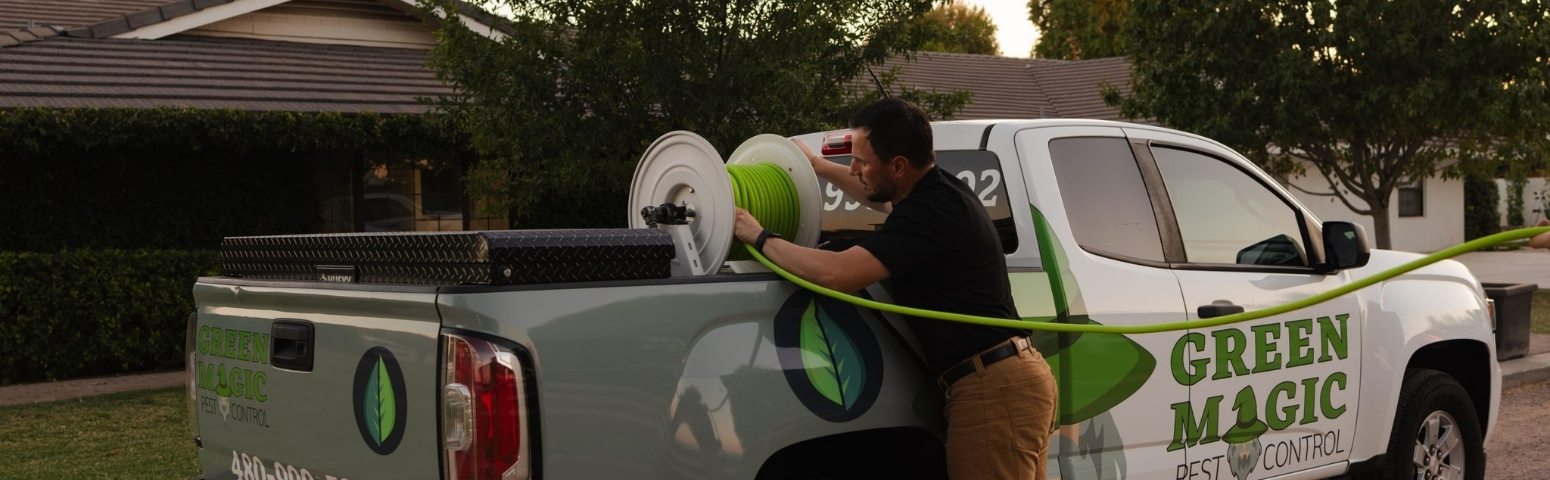
The technicians at Green Magic Pest Control are paid by the day rather than by the number of jobs completed, which means there is no incentive to rush through a yard inspection. The same family-owned approach that has defined the company since it was founded in 2016 applies to every Peoria AZ property: the goal is to solve the problem, not to schedule the minimum treatment needed to close the call.
Peoria AZ pest control services from Green Magic use organically derived, pet-safe, and child-safe products, which matters to families who use their outdoor spaces regularly. If your kids play on the lawn, your dog patrols the yard fence, or you simply want to know that what goes on your property will not harm what you care about, the eco-friendly approach is not a compromise. It is the standard.
To get ahead of pest pressure before the monsoon season changes the game, schedule a perimeter inspection and treatment through the Green Magic booking page. Same-day service is available for urgent situations, and the company backs all work with a “bugs gone or your money back” guarantee.
The Arizona Structural Pest Control Commission and Why It Matters
Pest control in Arizona is regulated by the Arizona Department of Agriculture Pest Management Division, which oversees licensing requirements, product use standards, and complaints against pest control companies operating in Maricopa County. Hiring a licensed and insured company protects you as a homeowner if anything goes wrong, and it ensures that the technician treating your yard has met the state’s training and safety standards. Green Magic Pest Control is fully licensed and operates in compliance with all Arizona state requirements.
Peoria AZ on the Map
Frequently Asked Questions
When does pest season actually start in Peoria AZ?
Pest activity in Peoria AZ begins to escalate in late April and May as daytime temperatures consistently exceed 90 degrees. Ants, scorpions, cockroaches, and termites all become more active well before the monsoon season begins in mid-June, making late spring the most important time to schedule a perimeter treatment.
Are scorpions in Peoria AZ dangerous to pets and children?
The Arizona bark scorpion found throughout Peoria and western Maricopa County is the only scorpion in the United States with a sting considered medically significant. Stings can cause intense pain and in rare cases more serious reactions, particularly in small children and pets. Perimeter treatment and Black Light Scorpion Service are the most effective tools for reducing scorpion populations around outdoor living spaces.
Do organically derived pest control products work as well as conventional treatments?
Organically derived and pet-safe products used by licensed pest control companies in Peoria AZ are effective for the pest pressures common in Maricopa County. The application method and coverage pattern matter as much as the product itself. A licensed technician who performs a thorough perimeter inspection and targets the correct harborage zones will consistently outperform any over-the-counter product applied without that knowledge.
Why do I keep seeing ants in my Peoria yard every summer even after I treat them?
Persistent ant problems in Peoria AZ yards are almost always the result of treating only the visible trail rather than the colony. Desert ant colonies live deep in the soil and can have multiple entry points across a large area. Professional treatment targets the colony with products that workers carry back underground, which eliminates the source rather than just the foragers you can see.
How often should outdoor pest control be done in Peoria AZ?
Most Peoria AZ properties benefit from quarterly perimeter treatments, with an additional pre-monsoon treatment in late May or early June to address the surge in pest activity that comes with rising summer temperatures. Properties near desert washes, open land, or with dense landscaping may benefit from more frequent service during peak season.
Green Magic Pest Control has served Peoria AZ and the wider Maricopa County area since Matt founded the company in 2016 with a straightforward promise: send skilled technicians who take the time to do the job right. If your yard or outdoor spaces are showing signs of pest pressure before the monsoons arrive, the team is ready to help. Schedule your perimeter inspection and treatment at greenmagicpest.com/book-now and let our bug wizards work their magic.