
If you have owned a home in Phoenix for more than a few summers, you already know the routine. Something shows up in the garage in June, you drive over to the hardware store on Thomas Road or Bell Road, you buy the biggest bottle with the trigger sprayer, and you walk the perimeter on a Saturday morning before it gets too hot. It works, sort of, for a couple of weeks. Then it is August, the monsoon has come through, and you are back at the same shelf buying the same bottle.
That cycle is not a failure of effort. It is a mismatch between what retail products are built to do and what actually drives pest pressure in the Sonoran Desert. Understanding where that line falls is the whole argument for Phoenix AZ pest control services, and it is worth walking through honestly, because there really are things you should keep doing yourself.
What the can on the shelf is actually built to do
A retail aerosol or ready to use trigger bottle is designed around one job: kill the insect you can see, right now, with minimal risk to whoever is holding the can. That means a low concentration of a pyrethroid active, pre diluted, in a formulation that flashes off quickly. It is a contact product. Point it at a cricket in the garage and the cricket dies. Nothing about that product is engineered to reach the other four hundred crickets living in the block wall cavity.
Professional materials are chosen the opposite way. The question is not what dies in the next thirty seconds, it is what happens to the population over the next eight weeks. That changes the chemistry, the formulation, the placement, and the equipment used to put it there. A licensed technician is also applying at the labeled rate for the site, which is a very different thing from guessing at a concentrate dilution over a garage sink.
The repellent problem nobody prints on the front label
This is the single biggest reason DIY treatments backfire in Valley homes. Most retail sprays are repellent. Insects detect the treated surface and avoid it. That sounds like exactly what you want until you think about where they go instead.
Spray a baseboard and the German cockroaches that were living behind the dishwasher do not die. They relocate into the wall void, the motor housing of the refrigerator, or the cabinet run on the other side of the shared plumbing wall. You just took one contained harborage and split it into several you cannot see. Homeowners then read the fresh sightings in the back bedroom as a worsening infestation, when what actually happened is that the population dispersed. The same dynamic is why bug bombs and foggers so often make things worse, and why plug in electronic repellers do not hold up under testing at all.
Non repellent products and gel baits invert the logic. Insects walk across the material, or eat it, without detecting a reason to flee, and then carry it back into the harborage on their bodies or in their gut. The transfer effect is the entire point. You cannot buy that outcome in an aerosol can.
Ants are a colony problem, not a countertop problem
Every long time Phoenix resident has stood at a kitchen counter and wiped out a trail of ants with a paper towel and a spray bottle. It feels decisive. It changes almost nothing.
The foragers you killed are a small and expendable fraction of the colony. The queen and the brood are somewhere else entirely, often under a slab, in an irrigation valve box, or nested in the moist soil along a drip line. Worse, several species common around Phoenix respond to chemical stress by budding, meaning a stressed colony splits and multiple satellite colonies establish where there was one. That is how a manageable trail on the patio in Arcadia or Ahwatukee becomes four separate trails by the end of the month.
Effective ant control works backward from the colony. It means identifying the species, following the trail to the nest, and choosing a bait or non repellent the workers will actually carry home. Get the identification wrong and the bait gets ignored, which is exactly what happens with generic retail bait stations sitting untouched on a countertop for three weeks.
Resistance is real, and it shows up in the kitchen first
German cockroach populations have developed documented resistance to several of the pyrethroid actives that dominate the retail shelf. If the bottle in your garage uses one of those actives, and the population in your building has already been selected for resistance by years of previous spraying, you are applying a product that a meaningful share of the insects will simply survive.
Professional programs handle this by rotating modes of action and leaning on baits with different chemistry. That is not marketing language, it is standard resistance management, and it is the reason a German cockroach treatment that follows a plan clears a kitchen while eight months of retail spraying does not. The Environmental Protection Agency covers the underlying framework in its integrated pest management principles, which combines inspection, sanitation, exclusion and targeted product use rather than treating chemistry as the whole answer.
Bark scorpions do not play by the same rules
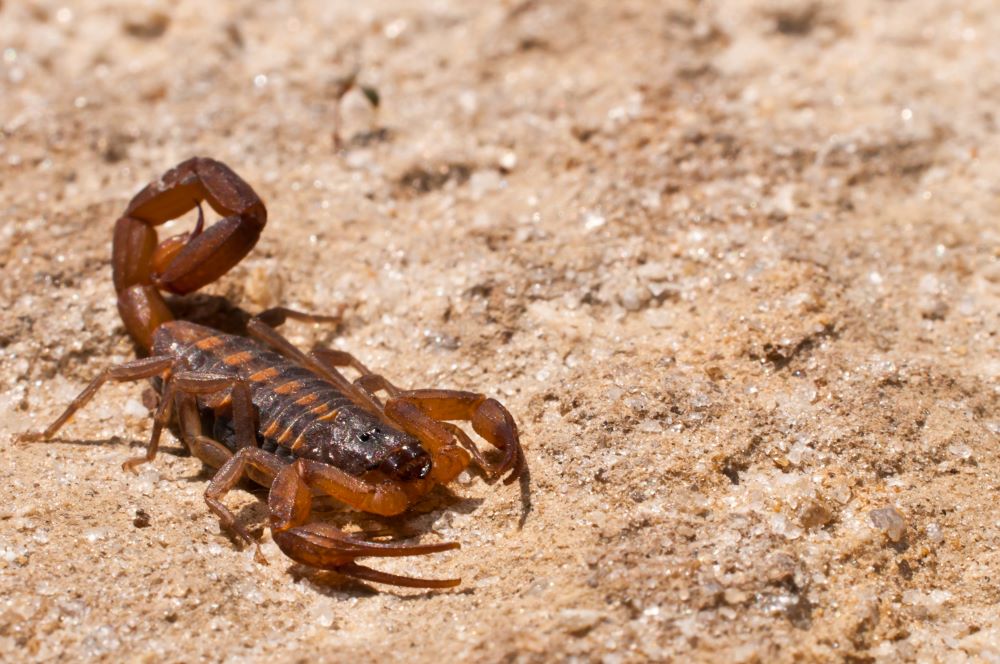
Scorpions are where the gap between DIY and professional work is widest, and it has nothing to do with product strength. The Arizona bark scorpion has a waxy cuticle that resists absorption, it does not groom itself the way an insect does, and it spends daylight hours pressed flat inside block wall cavities, under landscape rock, in stem wall gaps and behind loose stucco. A perimeter spray applied to the outside face of a wall does not reach any of that.
Homes along the Phoenix Mountains Preserve, up near Piestewa Peak, along the South Mountain edge in Ahwatukee, and anywhere backing to a wash or the Grand Canal live with steady pressure from the surrounding desert. Bark scorpion control in those areas is mostly a structural and behavioral problem: reduce harborage, seal the gaps, treat the voids and the food source, then verify. The Black Light Scorpion Service exists because scorpions fluoresce under ultraviolet light, which is the only practical way to find where they are actually sheltering after dark rather than guessing.
Reach, equipment, and the parts of a Phoenix house you cannot get to
Set chemistry aside for a moment. A one gallon pump sprayer reaches the bottom eighteen inches of your exterior walls and the visible baseboards inside. It does not reach a wall void, an attic, a weep hole course, a soffit, a utility penetration behind the stucco, or the cavity inside a block fence.
Those are the places that matter here. Roof rats move along the roofline and into attics through gaps you cannot see from the ground, which is why roof rat activity in Phoenix yards is so often traced to citrus trees and untrimmed palm skirts touching a fascia board. Rodent work is exclusion first and product second, and exclusion means finding and closing the openings. Getting a product into a void requires injection equipment, dusters and access most households do not have and should not be improvising.
Where doing it yourself genuinely earns its keep
None of this means the Saturday morning walk is wasted. The DIY side of the ledger is real, it is just not the spray bottle. It is everything that removes the conditions pests need.
Keep the block wall clear of stacked rock, firewood, pavers and stored bins. Fix the dripping hose bib and the leaking drip emitter, because in a desert climate reliable water is worth more to a pest than food. Trim tree limbs and palm skirts back off the roof and the wall line so nothing bridges into the structure. Pick up fallen citrus in Arcadia and the older central Phoenix neighborhoods where mature trees drop fruit all winter. Replace worn garage door bottom seals and weatherstripping, and screen the attic and dryer vents. Keep the kitchen tight on crumbs and grease, and take the trash out on a schedule.
That work is not glamorous and no product replaces it. It is also the difference between a treatment that holds for two months and one that gets overwhelmed in three weeks. A good pest control company in Phoenix AZ should be telling you exactly which of these apply to your property rather than just spraying and driving off.
The cost comparison people actually run
The honest version of the math is not one bottle against one service visit. It is a full season against a full season.
The DIY column includes the granules, the concentrate, the aerosols for indoors, the bait stations, the sprayer, and the repurchases every time the desert sun and the monsoon rain break down what you put out. Phoenix is unusually hard on residual products. Surface temperatures on stucco and block in July, relentless UV exposure, and heavy runoff during storm season all shorten how long anything stays active. The result is that a homeowner treating a perimeter properly ends up buying material more often than the label would suggest.
The professional column is a recurring service at a predictable price, with the interior included when something is active, and a warranty behind it. Green Magic technicians are paid by the day rather than per job, which removes the incentive to rush a property or upsell a service nobody needs. The guarantee is straightforward: bugs gone or your money back.
Where DIY gets genuinely expensive is in the failures. A termite colony working undetected while you spray for ants, a roof rat chewing wiring in an attic, a German cockroach population that establishes across a shared wall, or a bark scorpion sting that puts a small child in an emergency room. Those outcomes cost multiples of what a year of service costs. Long time Valley residents who have moved to year round protection usually did so after one of those bills, not before.
What the professional side actually looks like
A first visit is heavily weighted toward inspection. A technician walks the exterior, reads the block walls, the stem wall, the weep holes, the irrigation, the roofline and the vegetation, then works the interior for evidence rather than just spraying. Findings drive the treatment plan. You can see the scope of that in the breakdown of the initial pest control treatment.
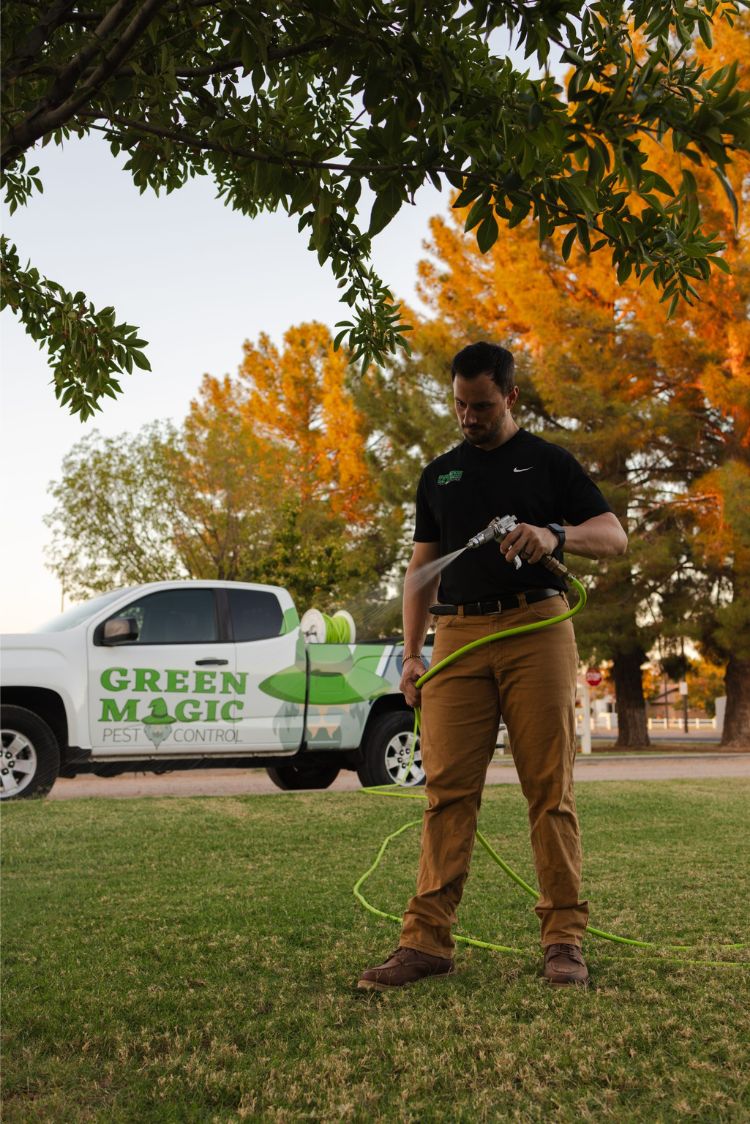
After that, recurring exterior service keeps a maintained barrier and harborage pressure down, with interior work added only when it is warranted. Same day service is available when something urgent shows up, and there is no pressure sales routine attached to it. If you want to skip the shelf entirely this season, book a visit with Green Magic and get a real read on your property. Matt and his team have been handling pest control in Phoenix AZ and across the East and Central Valley since 2016.
Frequently Asked Questions
Does store bought bug spray actually work on Arizona bark scorpions?
It kills the scorpion you hit directly and does very little after that. Bark scorpions have a waxy cuticle that resists absorption, they do not groom themselves the way cockroaches do, and they spend most of the day sealed inside block wall cavities and rock voids where an aerosol never reaches. Control comes from harborage reduction, sealing entry gaps and targeted product placement into the voids, not from spraying a baseboard.
Why do cockroaches seem worse after I spray my kitchen?
Most retail sprays are repellent, so the roaches you did not hit scatter away from the treated surface and push deeper into wall voids, appliance motors and neighboring rooms. You broke up one harborage and seeded three new ones. Gel baits and non repellent products work the opposite way, because insects carry the material back to the group instead of running from it.
How often do professional treatments need to be repeated in Phoenix AZ?
Most properties do well on a recurring exterior service every other month, with interior work added when something is active. Phoenix breaks products down fast. Summer surface temperatures on stucco and block, direct UV exposure and monsoon runoff all shorten residual life, which is why a treatment that would hold for months in a milder climate needs a tighter schedule here.
Is there anything I should keep doing myself between professional visits?
Yes, and it matters more than most people think. Keep block walls clear of stacked rock, wood and stored items, fix irrigation leaks and dripping hose bibs, trim tree limbs and palm skirts off the roofline, sweep up fallen citrus, and keep weatherstripping tight at the garage and exterior doors. That work removes harborage and moisture, which is the part no product can do for you.
Are professional products safe around pets and young children?
Green Magic uses organically derived products applied at labeled rates by a licensed technician, and treated surfaces are safe to return to once they have dried. The bigger safety gap is usually on the retail side, where concentrates get mixed by eye and aerosols get emptied into occupied rooms at rates the label never intended.
Green Magic Pest Control has served Phoenix and the surrounding Valley since 2016, when owner Matt built the company around a simple idea: pay technicians by the day so they take the time a property actually needs. Family owned, licensed, and using organically derived products that are safe for kids and pets once dry. Let our bug wizards work their magic, and schedule your Phoenix service here.